

How to Use Print Effectively for Your Christmas Campaign
Christmas rewards the businesses that plan early and make it easy for people to act. Print does both well. A card lands on the kitchen bench. A catalogue sits near the kettle. A voucher gets tucked into a wallet. A gift guide travels from the letterbox to the dining table and stays there longer than most messages on a screen.
That staying power matters during a crowded season. People are choosing gifts, booking services, planning meals, organising travel, and trying to keep a budget under control. A well-timed printed piece can cut through the noise because it feels tangible, useful, and deliberate.
The key is to treat print as part of the campaign, not as a last-minute decoration. Good Christmas print has a clear job, a strong offer, a simple message, and enough time to reach people before they have already made their plans.
Start with the decision your print needs to influence
Before choosing paper stock or folding styles, decide what action the printed piece should support. Christmas campaigns often fail when one flyer tries to do too much. A printed item works best when it has one main purpose.
That purpose might be:
Encouraging early bookings before the December rush
Promoting a seasonal gift range
Sharing holiday trading hours
Driving repeat purchases with a voucher
Inviting customers to an in-store event
Thanking loyal customers with a personal card
Helping people choose gifts through a guide or catalogue
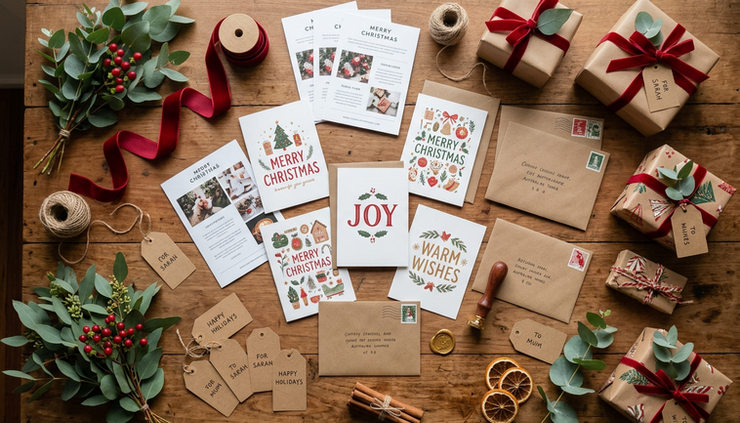
Each goal calls for a different format. A postcard suits a sharp offer. A folded flyer gives enough space for a small Christmas menu, service list, or gift range. A catalogue works when people need to browse. A gift tag or voucher can encourage a second visit after the first purchase.
The best question to ask is simple:
What should someone do within 30 seconds of reading this?
If the answer is unclear, the print piece is not ready.
A Christmas campaign also needs stronger timing than a standard campaign. Many people start planning earlier than expected, especially for gifts that need delivery, events that need bookings, and services with limited availability. Sending a beautiful mailer too late can waste the whole effort.
For Australian campaigns, factor in:
School holiday timing
Public holidays
Summer travel plans
Postage cut-off periods
Staff leave and production closures
Last order dates for delivery before Christmas
Boxing Day or January follow-up activity
A useful planning window starts well before December. Creative, copy, print production, packing, and delivery all take time. If customers need to place orders, book services, or visit a store, they also need breathing room.
Give every printed piece one clear message
Christmas design can get busy quickly. Snowflakes, baubles, gift boxes, gold foil, script fonts, festive borders, and product images all compete for attention. The more decorative the piece becomes, the harder it can be to read.
Good Christmas print keeps the message clear. The design can still feel warm and seasonal, but the reader should grasp the offer without working for it.
A strong print message usually includes five parts:
A clear headline:
Say what the piece is about. Avoid clever lines that hide the point.
A short reason to care:
Explain the benefit in plain language. This might be convenience, limited availability, a seasonal range, or a useful saving.
The main offer or information:
Put the key detail where the eye lands first. Do not bury it in body copy.
A direct next step:
Tell people exactly what to do next, such as book by a date, bring in a voucher, scan a code, or visit a location.
A deadline or timing cue:
Christmas is time-sensitive. A date helps people act now rather than later.
For example, a café offering festive catering does not need a flyer full of general praise. It needs a simple message such as:
Christmas platters are now open for pre-order. Order by 15 December for pickup before Christmas Eve.
That tells the reader what is available, what to do, and when to act.
A local service business might use:
Book your pre-Christmas appointment before the holiday rush. Limited December spots available.
Again, the message is clear. It respects the reader’s time.
Choose print formats that match the customer journey
Not every Christmas message needs the same printed format. The right format depends on where the reader is in the buying or booking journey.
Some people are only starting to think about Christmas. They need ideas. Others already know what they want and need a reason to act. Some are existing customers who need a reminder. Others may buy once in December and return in January if prompted well.
Here are practical ways to match format to purpose.
Print format | Best use | Practical tip |
Postcard | Short seasonal offer or announcement | Use one strong image, one offer, and one next step |
Folded flyer | Menus, service lists, event details, or gift ranges | Keep sections short and make dates easy to find |
Catalogue or gift guide | Product ranges with multiple options | Group items by price, recipient, or occasion |
Voucher | Repeat visits or gift purchases | Add clear terms and a visible expiry date |
Greeting card | Customer appreciation | Keep it personal and avoid turning it into a hard sell |
Poster or window sign | Foot traffic and in-store reminders | Make it readable from a distance |
Packaging insert | Post-purchase follow-up | Include a January offer or care instructions |
Gift tag | Add-on with purchase | Use it to create a small moment of delight |
A strong Christmas print campaign often uses more than one format. For example, a retailer might send a gift guide in November, place posters near the entrance in December, and include a January voucher in every purchase bag. Each item has a different role, but they all support the same seasonal goal.
A service business might mail a postcard to past customers, hand out appointment reminder cards, and include holiday closure dates on receipts or counter slips. That keeps the message consistent without repeating the same material everywhere.
The format should also match the value of the action. A high-value service or premium product can justify heavier stock, a refined finish, or a more detailed mailer. A quick seasonal discount may only need a well-designed postcard or insert.
Print quality matters, but it should serve the message. Thick stock can make a gift voucher feel more substantial. A matt finish can feel calm and refined. Gloss can help bright product photography pop. The finish should match the feeling you want people to have when they hold it.
Make design and copy work together
Print has a physical rhythm. People pick it up, glance at it, turn it over, scan headings, and look for the detail that matters to them. Design and copy need to support that behaviour.
Start with hierarchy. The most important information should look most important. If every line is bold, nothing stands out. If the headline, offer, deadline, and next step all fight for attention, the reader may miss the point.
Use space with care. White space is not wasted space. It gives the eye somewhere to rest and makes the message feel easier to understand. This can be especially helpful during Christmas, when designs are often packed with decoration.
Keep body copy short. Print readers rarely want long explanations on a promotional piece. Use plain words and cut anything that does not help someone decide.
A simple structure works well:
Headline
Short supporting line
Offer or key information
Dates and conditions
Contact details or next step
Think about readability too. Small type can look neat on a screen but become hard to read once printed, especially for older customers or busy environments. Avoid light text on busy backgrounds. Give phone numbers, dates, and codes enough size and contrast.
If you use a QR code, make sure it earns its space. A QR code should take people to a page that matches the print message, not a generic home page. For example, a Christmas menu flyer should link to the Christmas menu, booking page, or order form. Test the code before printing and print it large enough to scan easily.
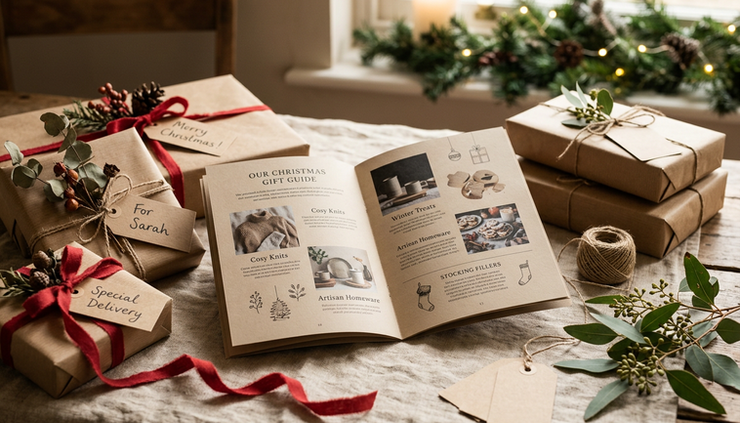
A gift guide can include prices and categories. A holiday hours card can include emergency or after-hours details if relevant. A food order flyer can include pickup dates, serving sizes, and storage notes. Useful print gets saved.
Connect print with the rest of the campaign
Print works best when it points people to the next useful step. That step might happen in a store, over the phone, on a booking page, through an order form, or during a return visit.
Use consistent wording across campaign touch-points. If the mailer says “Christmas Grazing Boxes,” the website, order form, and counter sign should use the same phrase. If the voucher says “Holiday Thank-You Offer,” staff should understand what that means and how to process it.
This reduces confusion. It also makes the campaign feel more polished.
Good ways to connect print with the rest of the campaign include:
A QR code linking to the exact offer or booking page
A short web address that is easy to type
A unique promo code for tracking response
A phone number for people who prefer to call
A map or simple location note for in-person visits
A reminder to bring the card or voucher back
A receipt insert that supports the same seasonal offer
Tracking matters because print can be measured. It does not need to be guesswork. Unique codes, dedicated landing pages, voucher redemption, call tracking, and customer questions at checkout can all show what worked.
Keep the tracking simple. A campaign can ask staff to mark each returned voucher, note how many orders came from a mailer code, or count scans from a QR code. The goal is not perfect data. The goal is enough information to make better choices next time.
Also think beyond Christmas Day. Some of the best print results come after the first purchase. A packaging insert with a January offer can bring people back when spending slows. A thank-you card can strengthen a customer relationship. A gift recipient voucher can introduce someone new to the business.
Christmas print should not stop at the sale. It can carry momentum into the quieter weeks that follow.
Plan production early and avoid the seasonal rush
Print involves real materials, machines, finishing, packing, and delivery. That is part of its value, but it also means timing matters. Leaving print until the last minute limits choices and can raise stress.
A practical Christmas print schedule might include:
Confirm the campaign goal and offer
Choose the format and quantity
Draft the copy
Prepare the design
Proof every date, price, phone number, and link
Test QR codes and promo codes
Approve the final artwork
Allow time for print production
Allow time for delivery or distribution
Brief staff before customers start responding
Proofing deserves special care. Christmas campaigns often include dates, order cut-offs, closing periods, terms, and limited offers. One wrong date can cause customer frustration and extra admin.
Before approval, check:
Spelling and grammar
Offer details
Product names
Prices
Trading hours
Expiry dates
Contact details
Website links
QR codes
Terms and conditions
Print margins and bleed
Print one proof at actual size if you can. Reading a design on screen is not the same as holding it. You may notice that the type is too small, the colour feels different, or the call to action is not obvious.
Distribution also needs planning. A beautiful piece only works if it reaches the right people. That might mean mailing to past customers, including inserts with orders, handing out cards at checkout, placing flyers in local delivery bags, or using posters where people already pause. Printcraft is also an Australia Post accredited bulk mail-house, which means we can print and mail your piece faster and cheaper than most of our competitors.
For nationwide campaigns, keep the message broad enough to suit different regions, but still specific enough to act on. Christmas in Australia often means summer holidays, end-of-year events, school breaks, travel, and outdoor gatherings. Seasonal print should reflect that reality rather than relying only on winter imagery that may feel out of place.
Use print to create a moment people remember
The best Christmas print feels considered. It does not need to be expensive or elaborate. It needs to be clear, well timed, and useful.
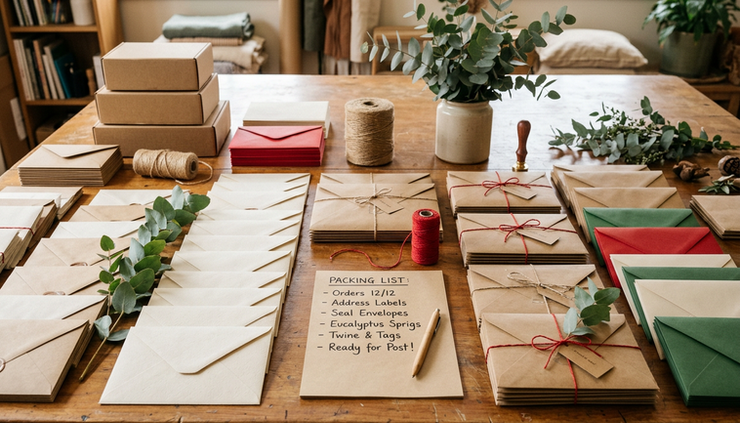
A handwritten-style note in an order can make a customer feel valued. A sturdy gift voucher can feel more presentable than a basic receipt. A well-organised guide can make shopping easier for someone who feels short on time. A simple holiday hours card can prevent confusion when routines change.
Small details can lift the experience:
Use paper stock that suits the purpose
Keep colours festive but readable
Add space for a handwritten name or note
Make vouchers feel giftable
Include clear care, storage, or pickup information
Use envelopes or inserts to make the piece feel more personal
Match the message to the stage of the season
Early in the season, help people plan. In mid-December, make decisions easy. After Christmas, give them a reason to return.
A strong printed campaign does not shout louder. It arrives in the right format, at the right time, with a message people can use. Start with the action you want, build the piece around that action, and give production the time it needs. Do that, and print can become one of the most reliable parts of your Christmas campaign.
To get started, submit an online quote through our website or call us on 07 3291 2444 to chat to a representative. We're here to help make the process smooth and stress free.


